
Reference · Desktop and system
Community package laws
Each community package is read as a graph and checked against named laws before it installs.
On this page
What it is
Community packages are build recipes that anyone can publish, collected outside the base distribution's reviewed repositories. Before one installs, WolOS reads its build recipe, install script and the code the build runs, and then watches the build itself in a sandbox. Both are checked against named laws, such as 'a credential reaches the network'.
Why
Nobody reviews what is published to the community package collection. A check that says 'safe' would be a lie, so this one only says whether a law was broken, and the sandbox stays the main defence.
How
- Check a package:
wopkg audit <package>shows one of four states: No Law Broken, Needs Review, Blocked or Not Checked. Read the finding. Blocked packages never install; Needs Review means read what was found first. The Store's Community tab shows the same check with each finding and where in the recipe it was found.
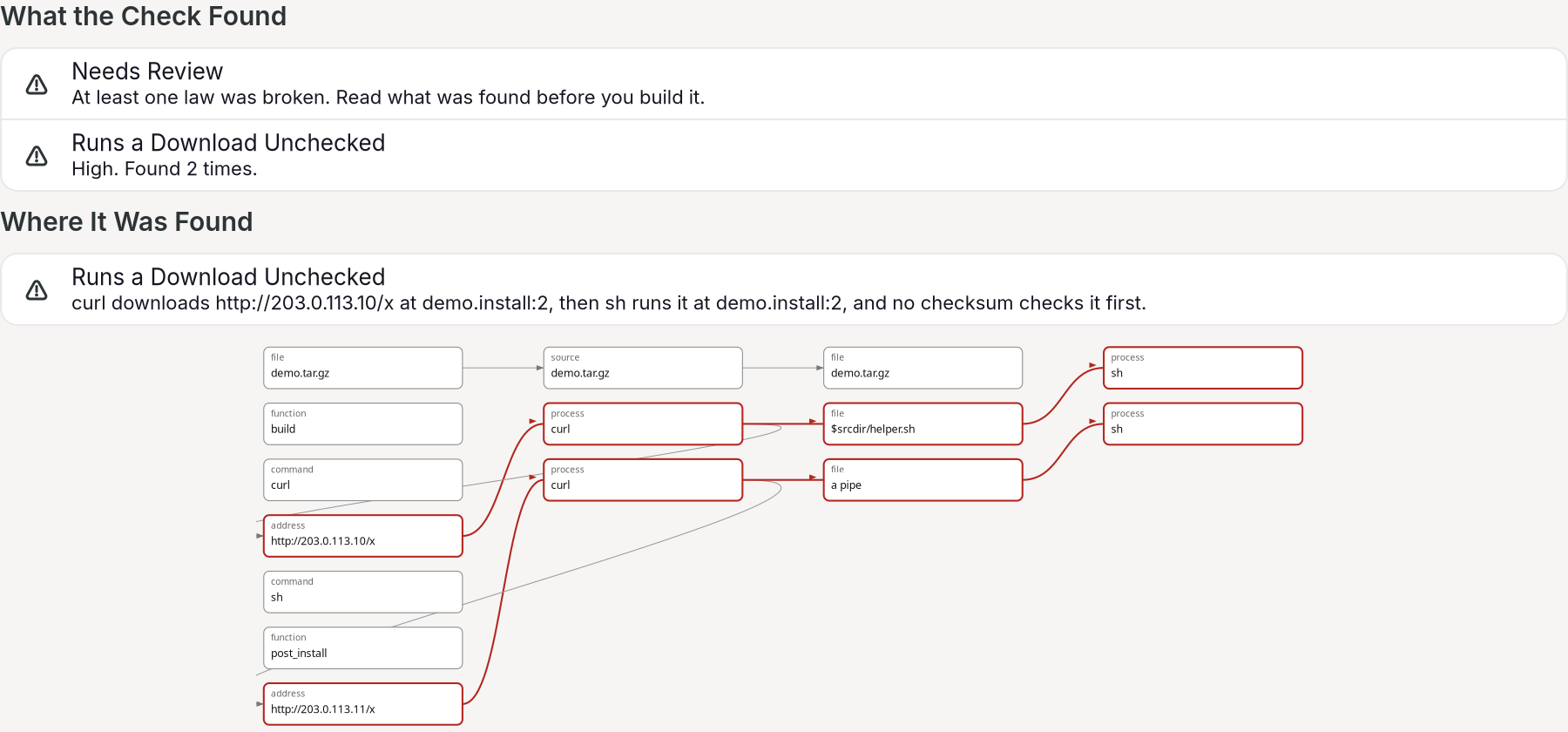
- Decide. Installing a community package stays a choice you make in Terminal, after the check.
If something goes wrong
| What you see | What to do |
|---|---|
| Needs Review | A law fired. Read the finding first; most packages that get this are fine, so expect to read some. |
| Blocked | The package never installs. |
| Not Checked | The check could not run. Nothing says it is safe. |
| No Law Broken | No named law was broken. It does not mean the package is safe. |
Related
wopkg · The Store (Community tab) · Privacy and permissions
Reference
The law checker for community packages: crates/aurlaws reads a package from the community package collection and answers one question: does it break a law? It never says a package is good. The sandbox stays the main defence.
What runs
wopkg-aurlaws --dir DIR [--artifact FILE] [--trace FILE] [--graph FILE] [--published FILE] --json
- The static graph. tree-sitter parses the PKGBUILD, the
.installfile, patches, and any shell, Python or other code the build runs. Nothing is executed. Only files the build reaches are judged; a file that sits unused is not. - The behaviour graph.
wopkgbuilds in its strict sandbox understraceand passes the trace. The trace has the same graph shape: processes, files, sockets. - The laws walk both graphs. Tags on nodes (
Secret,Outside,Autostart) come from Rust tables, and the shape of each law is the same one written inlaws/rules.bend.
Laws and states
Each law has a name people can read and a severity. wopkg audit <pkg> and the App Store's community-collection tab show the same names.
| State | Meaning |
|---|---|
| No Law Broken | The checks found nothing. That is no promise about the package. |
| Needs Review | A law is broken. Read the finding before going on. |
| Blocked | A credential reached the network, or the build did something grave. wopkg does not install it. |
| Not Checked | The checker did not run, or its answer could not be read. |
Every finding is a plain sentence with its file and line, or its trace line.
Numbers
Each freeze fixes the rules, commits a seed, then scores data drawn from that seed once. One author wrote both the fixtures and the laws, so read recall as an upper bound. "Benign" means popular and not known to be bad, not reviewed. Each freeze uses packages no earlier freeze used, and each benign set is less popular than the last, so freezes compare by shape, not to the decimal. The fixtures of each freeze are new, but the same author knew the techniques that came before.
| Measure | d61e821 | 3201717 | c4eff09 |
|---|---|---|---|
| Malicious fixtures, 40 flagged | 30 (75.0%) | 32 (80.0%) | 37 (92.5%) |
| Flagged by the law they name | 27 (67.5%) | 26 (65.0%) | 33 (82.5%) |
| Popular packages, 300 flagged | 59 (19.7%) | 44 (14.7%) | 25 (8.3%) |
source_off_upstream alone | 17 | 14 | 16 |
| High severity | 13 | 8 | 3 |
| Blocked | not recorded | 0 | 0 |
| Precision on the two sets | 33.7% | 42.1% | 59.7% |
Precision uses an artificial base rate: real uploads are nearly all benign. Time per package at c4eff09: 4 ms median, 204 ms at the 95th percentile, 4.8 s at most. Upstream source was read for 173 of the 300.
The rules of c4eff09 on the third set, now seen: 31 of 300 flagged before the last rule change, 44 before the round.
Traced test split, 36 packages, at 3201717, not rerun since: 22 built, 1 false finding (anydesk-bin). Build time x2.31 median on a KASAN kernel, so not a general figure.
At 3201717 the Rust checker and the Bend laws agreed on all 261 corpus graphs, and all 9 mutants that changed a rule broke a proof. At c4eff09 they agreed on all 178 graphs of the corpus run, and again all 9 mutants that changed a rule broke a proof.
Missed by the frozen rules: ftp and scp as the download, a tar source under a stranger's GitLab account. Flagged, but under another law: base64 <<<, tail and tr feeding a shell, Perl's LWP. A build.rs that runs what the environment names is still missed.
Limits
- A repository named after the package is trusted as its own upstream. A look-alike name under another owner is not.
- A name that matches only raises the bar for an unpinned source. It proves nothing alone.
- A traced build reads process and file calls. Data through a pipe between processes is not followed.
- The trace lives in the build folder, and the build can write there. A clean trace from a hostile build means little.
- A
makerecipe counts only if the build reaches its target, by what the package's files say aboutmake. A target known only at run time keeps every recipe. systemctl enableof a unit the package installs under its own name is not a finding, and neither is Python running a version file named inopen(). That file's contents are not read.- Upstream code is read leniently: only what runs in the build counts. Idle directories are not read.
- Reaching the network is not a mismatch when the package's own files name a URL that a process fetches, so a helper with its address in plain sight passes the trace check.
- Community-collection
-binpackages have upstream sums compared only when.srcor--publishedgives them. - Scriptlets are read, not traced.
Related
- wopkg: one tool for every sourcepacman repositories, Flatpak, AppImages, recipes and community packages behind one command.
- 0021: wopkgOne package tool for every source, with a stable library behind it.
- Plugin API referenceThe complete manifest, permissions and Lua API for shell plugins.
- 0031: Plugins, themes and layoutsFolder plugins in a sandbox, themes for every toolkit, and layouts as data.
- 0022: Community packages judged by lawsCommunity packages are judged by named laws over graphs, never called safe.
From the developer documentation, wonderlandos/wolos docs/modules/aurlaws.md.